Dye Penetrant Inspection
Precision in Testing, Excellence in Engineering
Dye Penetrant Inspection
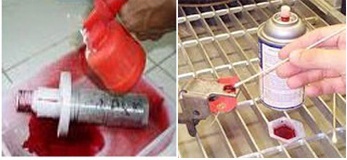
Dye penetrant inspection (DPI), also called liquid penetrant inspection (LPI) or penetrant testing (PT), is a widely applied and low-cost inspection method used to locate surface-breaking defects in all non-porous materials (metals, plastics, or ceramics).
Need Help?
Customer Services
+91 9822522259
Email Support
sales@svtechengineering.com
Other Services
- Third Party Inspection
- Welding Consultancy
- NDT Training Institute
- Calibration Services
The penetrant may be applied to all non-ferrous materials and ferrous materials; although for ferrous components magnetic-particle inspection is often used instead for its subsurface detection capability. LPI is used to detect casting, forging and welding surface defects such as hairline cracks, surface porosity, leaks in new products, and fatigue cracks on in-service components.
The test surface is cleaned to remove any dirt, paint, oil, grease or any loose scale that could either keep penetrant out of a defect, or cause irrelevant or false indications. Cleaning methods may include solvents, alkaline cleaning steps, vapor degreasing, or metal blasting. The end goal of this step is a clean surface where any defects present are open to the surface, dirt, and free of contamination. Note that if metal blasting is used, it may “work over” small discontinuities in the part and an etching bath are recommended as a post-blasting treatment.